
Catalog Articles Dragons First Time Here? Site Map Search Contact

Far left: De Morgan Fantastic Bird. Top: William Morris Bird and Trellis, William De Morgan Fish Tiles, William Morris Red House Garden Tile, Morris Poppy Tiles. Middle: Strawberry Thief, Beauty and the Beast Fireplace Side Panel, Brother Rabbit, May Morris Flower Pot. Bottom: William Morris 'The Forest' Hare, Captive Unicorn, William De Morgan Persian Dragon Huntington Golden Lily. Far right: William De Morgan Tree of Knowledge

I have been making tile in Morris designs since 2004, that followed a decades-long love with all things Morris and Arts & Crafts, Morris' values and ideals. I try to send these out into the world with the tile and in the way I do business. That has provided quite an education in the ways of the world and I've come to a better understanding of how he came to his political views.
I make:
Morris & Co. and William De Morgan reproduction tile,
A wider circle of Arts & Crafts tiles and some Art Nouveau tiles. My tiles will also work in a Craftsman home, but are not Craftsman style. More about Arts and Crafts Tile,
Tile based on Morris designs for stained glass and textiles,
Tile based on Preraphaelite and Medieval motifs.
I don't stock anything, except overruns and a very few samples. Each tile is made for you, which allows for some painless accommodations of color and size preferences. Every time I make tiles, I get a little better. You won't find my tiles in showrooms and if you are looking for a "source" for William Morris "style", I am not it. I can, at best, ship one tile order a week, although some murals may take as long as six weeks. And I am proud enough of my tiles that I think Morris would approve. You'll find things here that you can't find anywhere else, but you can find some similar early Morris patterns elsewhere of varying quality. Why these tiles then? I've given that some thought, too.
We (you and I) want your installation to reflect your best self and the spirit of those who live in that place, serving the needs of personality and lifestyle, without overwhelming its people, landscape, or architecture. With that in mind, I try to be easy to work with on design changes: If a flower should be a bit more pastel, or leaf more blue, or an entire element removed, it's all good. At the heart of it, I rather like breaking the rules sometimes. Not every change can be implemented in a way that maintains the integrity of the design at a reasonable level of effort, but we'll work together and come up with the right thing for you. In short, I am committed to communication.
I prefer to work with homeowners -- their enthusiasm for their homes, their creativity, it all makes me want to check mail in the morning. I've had some good experiences with architects; they've studied Morris and the Arts & Crafts Movement and they get Morris values. In particular, there are three architects I adore and cannot recommend highly enough: Paden Prichard in Oregon, Lewin Wertheimer in California, and Paul Helmer in Missouri. I work with interior designers on a limited basis. If you have a designer, you can still order tiles from me directly. I do not offer discounts "to the trade".

This is the first tile I made. May Morris, William Morris's younger daughter, was an amazing woman, not only for her time but for any time. When she was 23, she was the director of the embroidery department at Morris & Co. Flower pot was designed for an embroidered pillow implemented on tumbled marble. I talk about May Morris a bit more here. There is a longer article floating around in the back of my head.

My second tile set: Beauty and the Beast. The Prince, a side panel tile from the Beauty and the Beast tile set designed by Edward Burne-Jones for a bedroom fireplace overmantel and surround at 'The Hill', home of painter Myles Birket Foster, for Morris & Co. There are three sets of the Beauty and the Beast tiles and they are not identical. See a picture original Beauty and the Beast tiles. Other fairy tale tile sets from 'The Hill' are the Sleeping Beauty and Cinderella. All three were originally surrounded by swans. Some customers have installed the fairy tale tiles on staircase risers (pictures).

William Morris and Co. Membland Tile Panel: Membland was my most daunting project to date, with many false starts and giving up and restarting more than a few times over a course of several years. Membland was a collaborative effort between Morris and his friend, William DeMorgan. Morris designed the panels and they were executed by William De Morgan. The original panel consisted to 66 tiles - 60 six-inch tiles, and 6 3 x 6 tiles. The originals panels were installed side by side in a bath at Membland Hall. It is my intention to install them on my own stair risers.
Membland was the only panel design produced on such a large scale. William Morris designed it on commission to decorate Membland Hall in Devon by architect George Devey. The first set was hand painted on on Dutch blanks. Morris himself was unhappy with the quality of locally-made blanks and used imported blanks. De Morgan used his own Fulham Pottery tiles for subsequent panels.
Membland is very scalable. See Membland panels for backsplash and fireplace surround as accent tiles, borders, backsplash, and full panels.
In 2011, at the request of Ambassador Quinn, I was contacted by Gensler Architects and invited to do a series of tiles panels from The Books of Hours of the Duc de Berry for the World Food Prize Hall of Laureates in Des Moines, Iowa. The century-old Des Moines Public Library Building was restored as the Dr. Norman E. Borlaug World Food Prize Hall of Laureates. It serves as: a museum to recognize achievements in agriculture and fighting hunger; a convocation center to hold events; a home for the Global Youth Institute to inspire the next generation of leaders; an educational facility featuring interactive displays on hunger & food security; and a conference center and event space available to other groups and organizations.
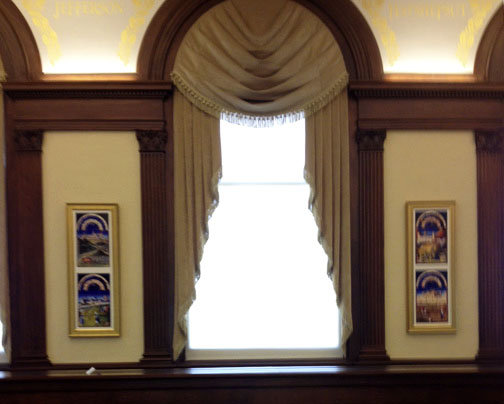
Over 100 pieces of specially commissioned artwork tell the stories of heroes such as Dr. Norman E. Borlaug, founder of the World Food Prize, as well as the 35 World Food Prize laureates, and features within the building also showcase the history of agriculture. It really is an honor to have my tiles there.
Morris & Co. often adapted designs for one medium for another and we've done that with our popular tiles from textiles. My first textile tiles were very true to the original implementations, as shown here in Willow and Brother Rabbit:

Tapestries: Morris did not like wallpaper, preferring tapestries. The offering of wallpaper by Morris and Co. was actually a concession because Morris wanted to make the decorative arts accessible to more people. Even so, the wallpaper was printed at Merton Abbey, sometimes handblocked, under his direct supervision. The Forest tapestry and the unicorn tapestries are listed with the other tapestry tiles in William Morris Textiles Designs.


Another large project, The Days of Creation spanned two years with more than six months of intensive work with the assistance of a number of people. The original painting of the Fourth Day was cut from its frame in a dining room in Dunster House at Harvard University in 1970 where the entire series was on loan from the Fogg Art Museum, and never been recovered.
Bringing the fourth angel back to life in color was a project that I lived and breathed while I worked on it. The restoration is based in part from Oscar Wilde's description and black and white platinotypes done by Frederick Hollyer at the end of the nineteenth century. The angels are available in several formats. They are featured in two scholarly articles that I know of, and an upcoming book, The Seven Days of Creation: Poetry and Art Inspired by the Torah and Other Scriptures by Jeff Jinnett.

Bestiary Dragons. In honor of Red House and the Victorian fascination with medieval culture (and mine), I took our emblem De Morgan dragon and created a bestiary. Nearly two dozen dragons are identified, roughly dated, and categorized. Following the bestiary theme, I have recently added medieval cats and medieval dogs, but there are not so many. These sets are added to as time goes on.

I've done a series of fantastic creatures by William Demorgan that include a fantastic bird, which make great fireplace side panels but also work as a backsplash,indigo ducks, and several polychrome tiles.
De Morgan started as a worker in stained glass at Morris & Co, but his interests and talents were in ceramics. There are more De Morgan tiles here than anything else, partly because he was so prolific but also because they work as well in traditional homes as in Victorian restoration homes and Arts & Crafts homes. The cobalt blue and white De Morgan ships and galleons tiles and the fantastic birds and animals are probably the most Victorian of his tiles. Many of his later, polychrome tiles are representative of his early Art Nouveau style.
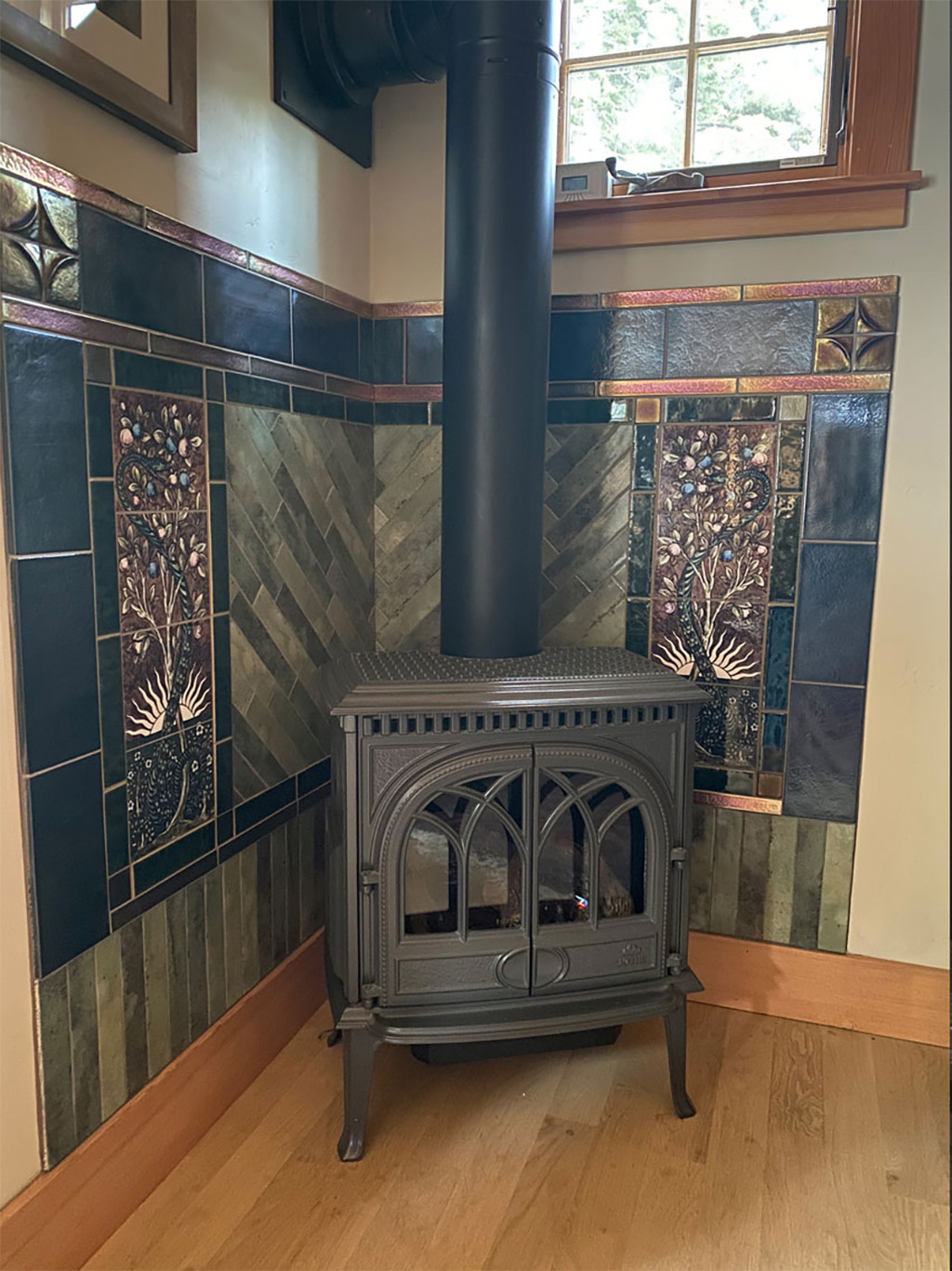
William De Morgan Tree of Knowledge on 6x8 inch tiles with Pratt and Larson field tiles.
De Morgan revisited serpents and peacocks the way Burne-Jones revisited the Days of Creation and Briary Rose, and the way Epping Forest haunts Morris's designs. Peacocks were a popular theme in medieval art and tile so naturally found their way into Arts & Crafts and later Art Nouveau. But what's with all the serpents? De Morgan's choice of serpents is not random. Snakes were a popular motif in the 19th century, so much so that Prince Albert gave the very first engagement ring to Victoria, a jewelry snake with an emerald-set head. Victorian snakes were the symbol of eternal love. Snakes also represented wisdom and eternity, choice, the dark and melancholia.
The Persian Serpents and some of the De Morgan Peacocks tile panels are representative of De Morgan's Persian era. Many tiles from this era are done in what he called a Persian color palette: Persian blue (a medium to dark blue), green, strong yellow, a slightly yellow green, with accents in varying shades of manganese purple, and Indian red.
The Kelmscott Chaucer tiles are 8 x 6 inches in cobalt blue and white.

Birds and Betrayal, a tile design based on the cover of William Morris's Story of the Volsungs and Niblungs. The cover was a William Morris and Philip Webb's collaboration. Both foreground and background colors can be modified. It has an interesting back story.

Get tile colors, options, pricing and more are on the individual pages, accessible by way of the catalog and sitemap.
morris and co. tile-making process


We sponsor Snicker at Blind cat Rescue.
news from elsewherelewin wertheimer, architect (based in southern california but does projects internationally)
david berman trustworth studios arts & crafts wallpapers (us)
christopher vickers arts & crafts furniture and metalwork (uk)
pasadena craftsman weekend (usually in the fall)
roycroft - east aurora arts and crafts show
Charities We SupportIf you would like to donate $10 to any of these charities, we'll subtract $10 from shipping of your order.
blind cat rescue and sanctuary
children's healing art project


